Hyaluronic Acid Filler Treatments
Soft tissue fillers are injectable treatments used to restore structure, support, and balance to the face. When used appropriately, they can help soften lines, improve proportions, and support facial harmony while maintaining natural expression.
At Wrinkless Medical Aesthetics Clinic, dermal filler treatments are doctor-led and anatomy-driven. The focus is never on adding volume indiscriminately, but on understanding facial structure, ageing patterns, and individual goals.
All treatments are carried out by Dr. Carol Mastropierro following a detailed consultation and full facial assessment..
Natural looking, always
Fillers have gained an unfair reputation, largely due to overfilled or poorly placed treatments seen in the past online and on media. In reality, filler itself does not create an unnatural appearance — the outcome depends on how much is used, the product thickness, where it is placed, and how well your own facial anatomy is respected.
A well-performed filler treatment should be undetectable, enhancing balance and support without making it obvious that anything has been done.
When used conservatively and placed correctly, fillers work to support the face rather than change it, maintaining natural expression and facial harmony.

Understanding Soft Tissue Filler
Soft tissue fillers are injectable treatments made of hyaluronic acid (HA) — a naturally occurring sugar found in the body, particularly in the skin, joints, and connective tissues, where it plays a key role in hydration and elasticity.
In aesthetic medicine, hyaluronic acid is stabilised and cross-linked in a controlled way. This process slows down its natural breakdown, allowing the filler to last significantly longer than the HA naturally present in the skin, while still remaining biocompatible and reversible.
The primary function of soft tissue fillers is
volumisation — replacing volume lost through ageing, supporting areas affected by bone and fat resorption, and restoring balance and proportions to the face. When used correctly, fillers do not simply “fill lines,” but work to rebuild structural support and achieve subtle, natural-looking rejuvenation.
What areas can be treated?
Lip filler
Lip filler can be used to enhance shape, definition, hydration, or symmetry of the lips. The aim is always to respect natural lip anatomy and proportions rather than creating excessive volume.
Treatment may focus on:
- subtle volume enhancement
- improved lip border definition
- correcting asymmetry
- supporting lip hydration and texture
Cheek Filler
Cheek filler is used to restore structural support in the mid-face, which can be lost over time due to bone resorption and soft tissue changes.
Rather than simply adding fullness, cheek filler aims to:
- support facial contours
- improve mid-face structure
- indirectly soften lower face heaviness or folds
Folds - nasolabial and marionettes
Nasolabial folds (smile lines) and marionette (nose to mouth) lines develop as facial support reduces and soft tissues descend over time. These areas are rarely treated in isolation.
Treatment may involve:
- restoring support in adjacent areas
- softening folds rather than eliminating them completely
- improving overall facial balance
Temples
Volume loss in the temples can contribute to a hollowed appearance and affect overall facial shape. Temple filler can help restore structural support and improve the transition between the upper face and the hairline, while improving the position of the brow.
This is an advanced area that requires detailed anatomical knowledge and careful technique.
Fine Lines Filler
very soft dermal fillers may be used superficially to improve the appearance of fine static lines, such as perioral lines around the mouth, horizontal neck lines, or other superficial skin creases.
This approach focuses on skin quality and subtle support, rather than volume replacement, and requires careful product selection and technique. Not all fine lines are suitable for filler treatment, and additional skin-based treatments may be more appropriate in some cases.
Under eye - Tear trough
Tear trough filler is used to address hollowing beneath the eyes that can create a tired or shadowed appearance. Treatment in this area focuses on restoring subtle support, and is only suitable for selected patients following careful assessment.
The tear trough is an anatomically complex area, and treatment is approached conservatively to maintain natural contours and minimise the risk of heaviness or puffiness.
Chin and Jawline
The chin and jawline play a key role in facial proportions and profile balance. Dermal filler in this area may be used to:
- improve chin projection or shape
- optically slim the face
- enhance jawline definition
- support lower face structure
- mask the appearance of jowls
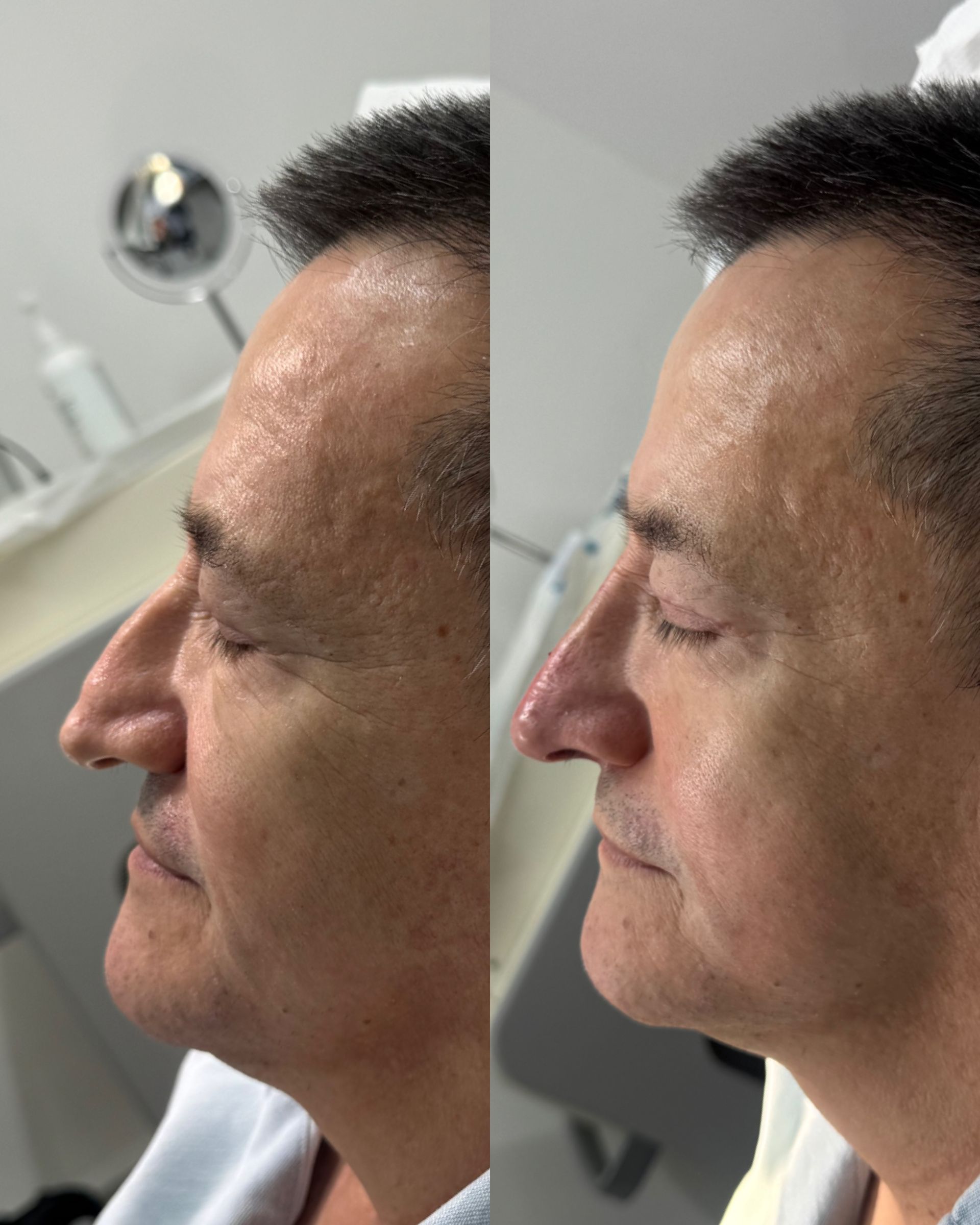
Nose filler
Nose filler can be used to improve the appearance of the nose without surgery by addressing concerns such as mild asymmetry, small dorsal humps, or lack of definition. Rather than making the nose smaller, filler works by creating balance and smoother contours in relation to the rest of the face.
This is an advanced treatment and suitability is carefully assessed, as not all nasal concerns can or should be treated non-surgically.
Downtime, duration, and reversibility
Downtime following dermal filler treatment is usually minimal. Some temporary swelling, tenderness, or bruising can occur, depending on the area treated and individual healing response. Most patients are able to return to normal daily activities shortly after treatment.
The duration of dermal fillers varies and depends on several factors, including the area treated, the thickness and type of filler used, and individual characteristics such as metabolism, lifestyle, and facial movement. While some areas may show visible effects for several months, others may retain filler for significantly longer.
It is also important to allow time for filler to fully settle. Initial swelling can temporarily exaggerate results, and final outcomes are usually best assessed 2–4 weeks after treatment, once the filler has integrated into the surrounding tissues.
Hyaluronic acid-based
fillers are reversible. If filler has been placed elsewhere and you are unhappy with the result, or if refinement is needed, it can be reduced or removed using an enzyme called hyaluronidase. This option adds an important layer of safety and allows treatment plans to be adjusted thoughtfully when required.